Tiny Organisms, Big Flavor: How Japanese Yeast Science Is Quietly Changing What's in Your Glass
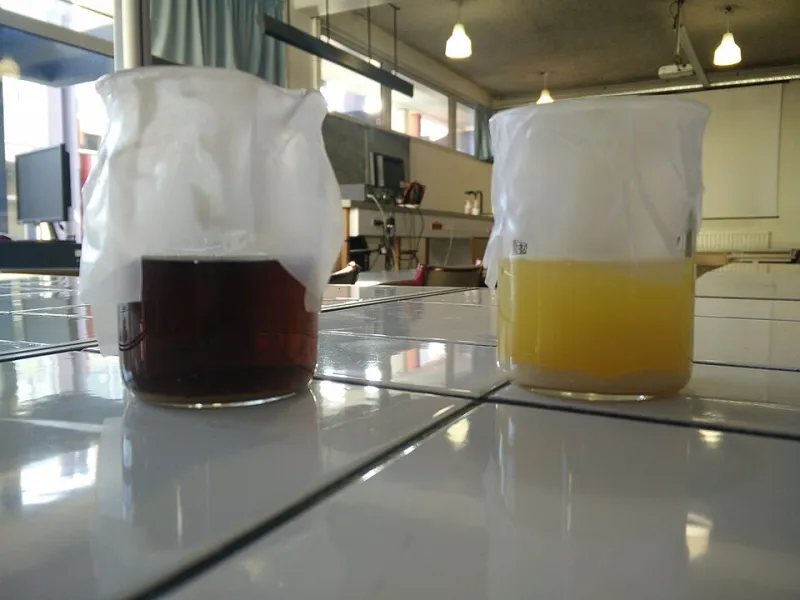
Photo: Aumars, CC BY-SA 4.0, via Wikimedia Commons
You can't see them. You can't taste them directly. But the microorganisms doing their invisible work inside a fermentation vessel are responsible for everything you love — or don't love — about a beer. Hop bitterness, malt sweetness, fruit esters, that funky barnyard note you either seek out or run from. All of it traces back, in some fundamental way, to yeast.
For most of American craft brewing's history, the yeast conversation has been dominated by a pretty narrow cast of characters: a handful of British ale strains, some Belgian heavy hitters, classic German lager cultures. Reliable. Well-documented. Beloved. But a quieter revolution has been building in the background — one that originates, in large part, from Japanese microbiology research — and it's starting to show up in the flavor profiles of some seriously interesting beers on this side of the Pacific.
At Itabashi Brewing Co., we've had a front-row seat to this shift. Itabashi Ward has long been home to small-scale manufacturing, technical craftsmanship, and a deeply ingrained culture of getting the details right. That same precision has found its way into the fermentation labs and brew houses that have quietly flourished here. And the science coming out of those spaces? It's catching the attention of brewers from Portland to Pittsburgh.
What Makes Japanese Yeast Research Different
Japan has a fermentation culture that goes back centuries — sake, miso, soy sauce, mirin, shochu. Long before craft beer was even a concept, Japanese scientists and artisans were developing a sophisticated understanding of how microorganisms transform raw ingredients into something extraordinary. That deep institutional knowledge didn't stay siloed in the sake industry.
In the last two decades, Japanese brewing researchers have isolated and cultivated yeast strains specifically adapted to produce flavor compounds that fall outside the typical Western brewing palette. We're talking about strains that express elevated levels of specific esters — fruity, floral, sometimes almost candy-like — without the accompanying alcoholic heat or off-flavors that less refined cultures might throw off. Others are prized for their ability to attenuate cleanly at lower temperatures, producing lager-adjacent clarity in ale fermentation windows.
The Brewing Society of Japan, along with university programs at institutions like Tokyo University of Agriculture, has published research on yeast behavior that American brewers are only now beginning to absorb into their practice. It's not that this information was hidden — it's that the language barrier and the geographic distance meant most US brewers weren't reading it.
That's changing fast.
The Cross-Pacific Knowledge Exchange
Brewers who have spent time in Japan — either studying, collaborating, or just drinking their way through Tokyo's craft beer scene — come back talking about fermentation character in a different way. There's a precision to the flavor building that goes beyond recipe formulation. It lives in the yeast selection, the fermentation temperature curve, the timing of dry-hop additions relative to active fermentation.
Several American craft breweries have started sourcing Japanese yeast cultures directly, either through formal licensing arrangements or through the kind of informal exchange that happens when two brewers who respect each other's work share a pint and a conversation. The results are beers that don't taste quite like anything else on a tap list — not because they're trying to be weird, but because the microbial engine driving them is producing a genuinely different flavor signature.
One brewer in the Pacific Northwest — who asked to remain unnamed because the strain sourcing is still in a proprietary gray zone — described it this way: "It's like switching from a piano with 88 keys to one with 120. You're not playing different music, but suddenly there are notes available to you that you didn't have before."
That's a pretty good way to put it.
Esters, Thiols, and the Chemistry of Distinction
For the science-curious among you, here's a quick breakdown of what's actually happening at the molecular level when a Japanese-derived yeast strain does its thing differently.
Esters — the compounds responsible for fruity aromas — are produced when yeast metabolizes sugars and generates alcohol. Different strains produce different ester profiles, and the ratios matter enormously. A strain that produces high levels of isoamyl acetate (banana) alongside ethyl acetate (solvent-adjacent) is going to be a problem. A strain that generates isoamyl acetate cleanly, without the unwanted companions, is a treasure.
Japanese researchers have done significant work on understanding the genetic and environmental factors that govern ester production, and some of the strains they've developed or documented are remarkably clean ester producers — expressive without being cluttered.
Thiols are another area of active interest. These sulfur-containing compounds, when present in the right concentrations, contribute tropical and passion fruit aromas that beer drinkers have gone absolutely wild for in recent years. Certain yeast strains are dramatically more efficient at releasing bound thiol precursors from malt and hops than others. Japanese research institutions have been mapping this territory carefully, and the practical applications for hop-forward beer styles are significant.
What This Means for the Beer in Your Hand
If you've had a beer recently that tasted cleaner, more precise, or carried a fruit character that felt almost architectural in its clarity — there's a decent chance Japanese fermentation science had something to do with it, even if the label doesn't say so.
At Itabashi Brewing Co., this intersection of tradition and technical rigor is exactly the kind of thing we get excited about. Itabashi's identity was built on craft — on people who cared enough about their work to keep refining it long after "good enough" would have been acceptable. The yeast researchers and the brewers who are learning from them are operating in that same spirit.
American craft beer has always been good at borrowing, adapting, and making things its own. The German lager tradition, Belgian wild fermentation, British cask ale — all of it got absorbed, riffed on, and pushed somewhere new once it landed in American hands. Japanese fermentation science is next in line for that treatment, and honestly, we can't wait to see where it goes.
The Conversation Is Just Getting Started
There are still real barriers — language, distance, intellectual property questions around proprietary strain development, and the basic challenge of maintaining live yeast cultures across international supply chains. None of those problems are insurmountable, and the brewers who are serious about this work are finding ways around them.
Collaborative brewing events, academic exchange programs, and the simple fact that the global craft beer community is increasingly well-connected mean that the flow of fermentation knowledge between Japan and the US is only going to accelerate. What's been a trickle over the last decade is starting to feel like something with real momentum.
The yeast is doing its thing, invisible and tireless, converting sugars into something worth drinking. The scientists who understand it best are pointing in a direction that American brewers are just beginning to follow. Pull up a stool. The next round is going to taste a little different — and a lot better.